

Gotta Travel On: Tales of Touring Abroad

The audience for bluegrass music extends beyond the United States. Every year dozens of bluegrass bands tour in foreign lands, especially Europe and the United Kingdom.
Playing abroad can increase a band’s audience and provide members with new travel, culinary, and cultural experiences. But the travel complications can be unexpected and confounding. The Bluegrass Standard invited several musicians to share their experiences traveling and performing abroad.
Unsurprisingly, simply making the trip can be problematic.

Before John, Jason, and Jeremy Chapman opened The Acoustic Shoppe in Springfield, Missouri, they toured widely with their father, Bill, as The Chapmans. Their second trip to Europe left a lasting impression.
“My brother has a Martin 1940 D-18 guitar that he loves,” says Jeremy. “And he had it in a Calton case, which are pretty much indestructible except for whatever airline we were flying to Amsterdam. They found a way to close it in some kind of hydraulic press and crush the neck of the case. When they wheeled it out, and he saw it, his heart was completely broken. He was scared to open it.”
But sometimes travel disasters are averted.
“The case did its job and protected the guitar,” says Jeremy. “So kudos to Calton for protecting it and to the airline for finding a way to destroy a carbon fiber or fiberglass guitar case. But that's one of our scariest mishaps flying in Europe.”
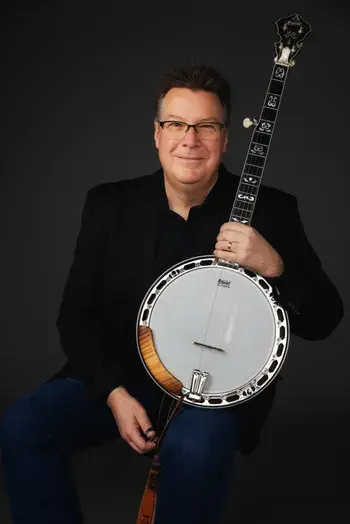
Banjoist and SiriusXM host Ned Luberecki is a little more relaxed traveling as a musician in Europe. That’s in contrast to flying in the States, where he always worries about getting his instrument safely stowed with him in the cabin.
“But I've had really good luck in European airports, including Amsterdam, Munich, and Heathrow, where it just seems like a less stressful situation. And even in situations where I have had to ask, ‘Hey, can I get this on the plane?’ instead of getting an attitude of ‘Oh, you're not getting that past me!’ like I might get in the States …over in Europe and other countries, I've never had that attitude.”
Overseas venues vary widely and may provide a memorable experience. You might be playing Albert Hall. Or not, as fiddler/singer/bandleader Becky Buller discovered.
“A couple times when I was touring with Valerie Smith and Liberty Pike, we played in a half of a wine cellar in Oberotterbach, this tiny town up a hill in Germany. And the name of the venue was the Musikantebuckl. And it was absolutely tiny. I can't remember how many people it held, but their big thing was that they would serve you a piece of toast with ham on it, and a half of a canned peach and some cheese over the top of that, and they would melt the cheese on top of that. And that was their speciality. It was good!”

Mandolinist David Benedict of The Foreign Landers has traveled widely. On a trip to Australia with the band Mile 12, they nearly had to leave behind one of their own.
“Our bandmate, BB Bowness, a phenomenal banjo player who’s from New Zealand originally, was a green card holder in the States. But when we got to Australia, her wallet got lost or stolen or something, and it had her green card in it. We were freaking out, thinking that she wouldn't be able to get back into the States when we flew back to America.”
To sort things out, the band had to wake at 3 a.m. to make a frantic four-hour drive between gigs to the American consulate in Sydney.
“And I just remember at dusk, seeing all these kangaroos hopping in the distance on this panic trip to the U.S. embassy to try to beg for BB to get back into the States. And thankfully, everything worked out.”

Mandolinist Jason Bailey played on a European tour with singer/songwriter Kristy Cox. His trip was a reminder of why traveling abroad can be worth the challenges. One of their stops was a performance at the Prucha banjo shop in the Czech Republic, a country with many fervent bluegrass fans.
“That was probably one of the warmest and more fun shows for me personally,” Bailey remembers. “They applauded after every solo. They knew a lot of the material that we were doing, and we just hung out after the gig jamming, which doesn't happen at most gigs. Usually, you do your performance and you shake some hands and pack up and leave. But this one, we hung out and jammed tunes with people because they loved it. And that's what bluegrass is all about, in a way. It's about the community, everyone getting together, playing tunes together. And so that was one of the more special moments over there.”


Comments