

Pickin’ On Post Malone: Finding the Song

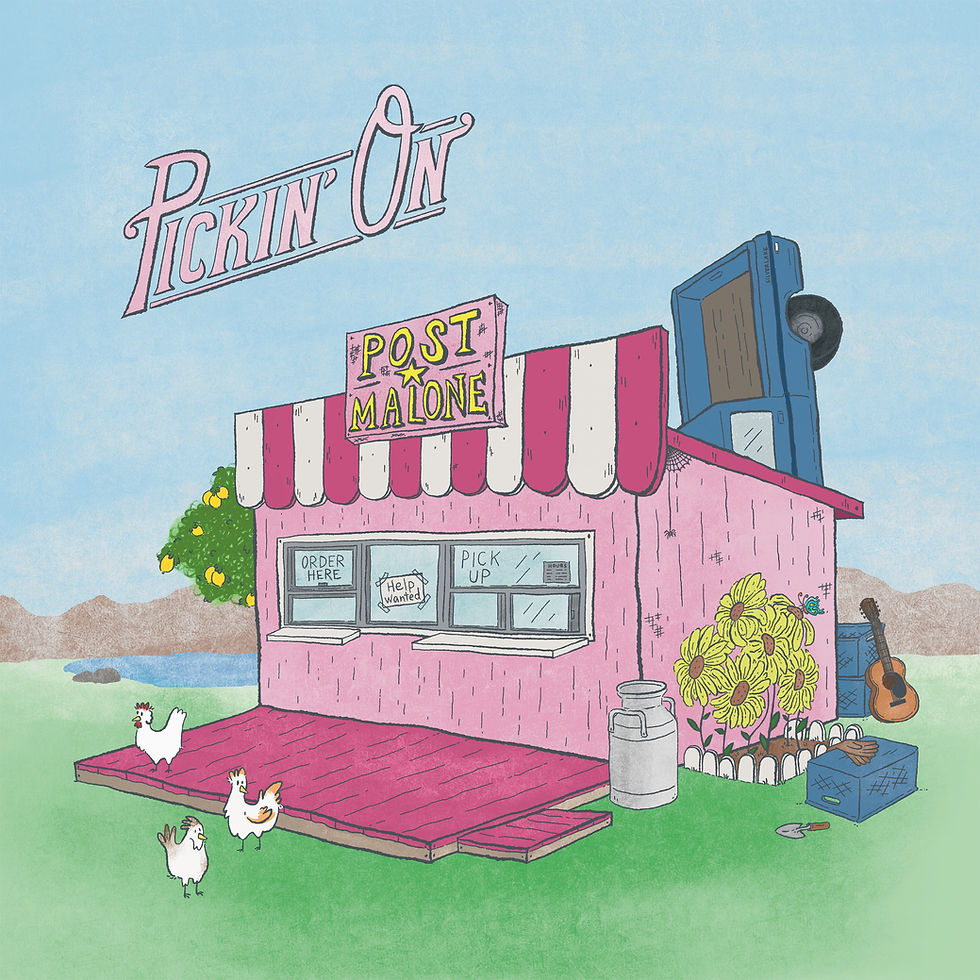
For more than three decades, CMH Records’ Pickin’ On series has taken songs that seem to belong somewhere else and asked what remains when familiar production is removed. Pickin’ On Post Malone, released July 31, may be one of the series’ more revealing tests, moving through a catalog shaped by trap, pop, hip-hop and country to find out what survives when banjo, mandolin, fiddle, dobro and guitar take over.
The album brought together Water Tower, Big Richard, JD Casper, The Barefoot Movement, Holler Choir and longtime contributors Iron Horse, with guest appearances from rapper MyVerse and Sean Jacobs. The twelve-song collection reaches from “White Iverson” and “rockstar” through “Sunflower” and “Circles” to newer material such as “I Had Some Help.” The question was what might happen to the material that seemed furthest removed from bluegrass.
Jeremy Stephenson said Post Malone became interesting partly because his move toward country had already opened the door between genres.
“We were, ‘Well, I wonder what the rest of his catalog would sound like if it was country or bluegrass,’” he noted.
Jeremy Harbin saw the challenge in the earlier records, where the connection to bluegrass was less obvious.
“The more country stuff’s gonna lend itself pretty easily to bluegrass,” Harbin said, “but then it’s kind of like the fun element of the earlier material that’s some brand of trap music. What’s that gonna sound like bluegrass?”
Answering that question required more than replacing electronic production with acoustic instrumentation. Stephenson and Harbin wanted the arrangements to sound like the musicians making them, so the artists were given latitude in choosing songs and deciding how far to take them. With the exception of Iron Horse, every group was new to the series.
Harbin described that change as a way of refreshing both the album and the larger series. “We wanted to inject some new energy into the series. It was just time to get some new talent and some fresh energy.”
Los Angeles-based Water Tower fit that approach well. The band already moves between bluegrass, old-time music and punk, while singer Kenny Feinstein knew Post Malone’s music firsthand. Water Tower’s version of “Sunflower” became the first single.

Feinstein said “Sunflower” suited the way Water Tower divides its vocals between two lead singers, allowing the group to reinterpret the exchange between Swae Lee and Post Malone naturally. “That was a perfect way to showcase our two-lead singing thing, ’cause Swae Lee does the first verse and then Post Malone does the second verse, and then they kind of interact back and forth.”
The approach became less predictable on “rockstar,” where Water Tower brought MyVerse into the arrangement rather than removing rap from the equation. The choice clarified an important point: the goal was not to sanitize Post Malone into something traditional, but to discover how much of his musical character could remain while the surroundings changed.
Stephenson admitted that the rapper’s appearance initially gave him pause, even though he trusted Water Tower’s instincts.
“I trusted Kenny,” Stephenson said, “but there was definitely the question of ‘Do you put a rapper on?’ I could go either way. But it flowed well and just felt like it was a part of the original song.”
Other performers pushed the songs in different directions. Stephenson and Harbin pointed to The Barefoot Movement’s “Wrapped Around Your Finger” and Big Richard’s harmonies as arrangements that surprised them, particularly because some participants had not been devoted Post Malone listeners. That distance may have helped them hear the compositions rather than recordings that had to be reproduced.
JD Casper came to the assignment from another direction. Raised around traditional picking and mountain music in Pennsylvania before moving to Austin, he had already reimagined emo and pop-punk through bluegrass with his EMOGRASS project.

Casper said the Post Malone songs proved surprisingly willing to move into an acoustic setting. “Sometimes you expect a pop song to fight against a traditional arrangement, but these really didn’t. Once we stripped everything back to the core melody and lyrics, the bluegrass versions came together pretty quickly.”
For Casper, preserving the original emotional center rather than proving they could be played on traditional instruments was the real challenge. Acoustic renditions can make almost anything sound like bluegrass, but authentic results only produce a new arrangement that still carries the song’s character, so it was a matter of authenticity rather than adhering to the genre’s sound.
“The challenge wasn’t making them sound bluegrass,” he said, “it was making them sound authentic and making sure they still carried the emotion that made the originals so good in the first place.”
“Those songs naturally translated to acoustic instruments,” he continued. “A strong melody and good songwriting will always shine through, whether it's played with electric guitars or a banjo and mandolin. I was looking for songs that had room to breathe in a bluegrass setting and could tell a story in a different way. Once we started arranging them, they almost felt like they'd always belonged in that style.”
Removing the surface of the original productions exposed melody, chord movement and emotion without the sonic elements most listeners associate with Post Malone. Bluegrass became less a destination than a way of examining what had been there all along, and Stephenson wanted to hear that. He described the process as a stripping-down that revealed the compositions underneath.
“It just strips away all the polish and brings out the essence of the song,” he noted. “You just see the song underneath it all.”
Feinstein heard that transformation most clearly in Water Tower’s “White Iverson,” whose original depends heavily on airy vocals, the weight of the beat and 808s. Rebuilt with acoustic instrumentation and dobro, the song moved far enough from its original setting to reveal another identity without losing the essence.
Feinstein said the bluegrass version took the song somewhere he had not expected.
“It just lifted off into a whole different place, and when you hear it, it doesn’t totally sound like a Post Malone song even. It is, but it just really works great in the bluegrass kind of style and totally transformed.”
Water Tower had already begun incorporating “White Iverson” into its live performances, turning music associated with an earlier part of Feinstein and his bandmates’ lives into part of their own repertoire. The project had moved beyond reinterpretation and into the band’s continuing musical identity.
Feinstein said performing the material altered the meaning of songs that had been familiar long before the project arrived.
“Getting to sing these lyrics and experience them in our genre, it totally changes the experience and the feel of the lyrics and just how much it means to us.”
Pickin’ On Post Malone works because it does not ask its musicians to arrive at the same answer. Water Tower found places where Post Malone’s music could coexist with punk-bluegrass instincts; Casper looked for melody and emotion strong enough to survive a stripped-down arrangement, and the other bands approached the catalog from their own experiences. What connects them is a willingness to listen beyond the production and find the meaning for themselves.
After more than thirty years, the Pickin’ On method is familiar, but Pickin’ on Post Malone proved that the territory it can explore is still difficult to predict. The project remains firmly about his melodies, lyrics and catalog, yet it also demonstrates how much identity a strong song can retain after nearly everything surrounding it has changed.
Bluegrass did not need to prove that Post Malone secretly belonged to it; it simply gave the songs another home for delivering those emotions, ideas, and a poet’s unique voice.


Comments