

Renowned Folk Artist Noel Paul Stookey’s Manulenjo: Could It Find a Home in Bluegrass?

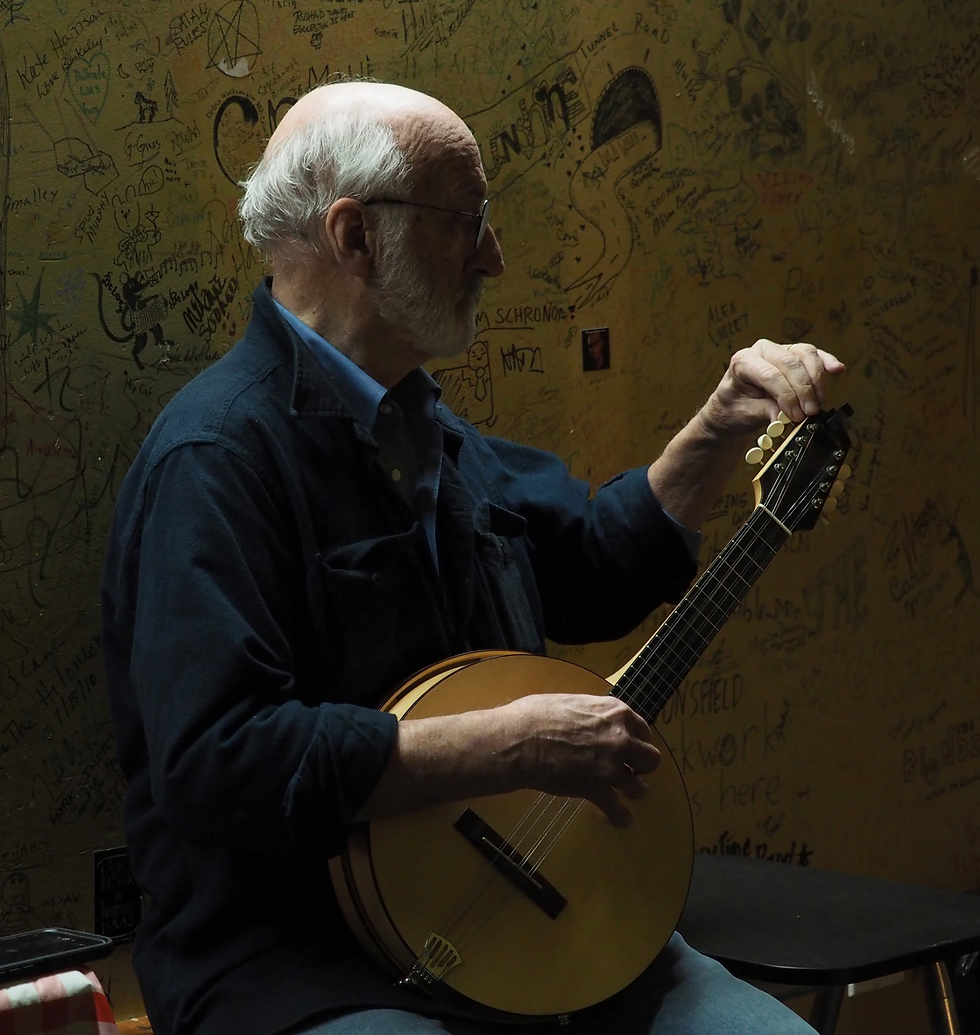
With five Grammy Award wins, eight gold albums, hundreds of television appearances, and a Lifetime Achievement Award, Noel Paul Stookey is still as creative as ever.
Designing a new instrument might not have been his lifelong ambition, but design one, he
did. The still-vibrant Stookey, 88, can add
inventor to his list. “I realized that what I had created was kind of a United Nations of instruments of sorts,” Stookey says.
Stookey is not the first person who comes to mind when you think of bluegrass, but his Manulenjo prototype, nicknamed Manny, could someday wind up in the hands of someone like Chris Thile, Jeff Austin, Sam Bush, or Sierra Hull.
The Manulenjo, pronounced man-U-LAIN-Yo, with a Spanish-style “j” sound, is a unique, custom-built acoustic hybrid instrument, conceived by Stookey and built by craftsman David LaPlante.
Anyone with knowledge of bluegrass instruments will recognize that the resonator guitar, too, was once an exotic instrument—that is, until Lester Flatt and Earl Scruggs hired comedian and bassist Buckett ‘Uncle Josh’ Graves, who wound up playing dobro for The Foggy Mountain Boys. Today it’s a staple—think Jerry Douglas.
“In terms of it crossing over into bluegrass,” explains Stookey, “I would imagine if somebody flat-picked it, you know, like many people do the mandolin, it could have an edgier sound.
“And certainly if you take the resonator off the back, it really cuts. I mean, it's really edgy.”
Combining a banjo, mandolin, and a ukulele, the Manulenjo represents three musical traditions: mandolin (Italian), ukulele (Portuguese), and banjo (African).
“Together with [guitar luthier] David LaPlante, who has built both of the guitars that I use on stage and did a lot of repair work for me in the ’70s and ’80s, I just couldn’t help but design with him this strange-looking marriage between a mandolin, a banjo, and a ukulele.”
As for the “uke,” as Stookey refers to it, he has a history with the instrument.
“I was brought up on the ukulele when I was a little kid, so ‘My Dog Has Fleas’ came pretty naturally to me.” [laughs]
What the Manulenjo came to represent
Inspired by the instrument, Stookey wrote the song “Dance to the Manulenjo.” “The song ‘Dance to the Manulenjo’ came, which was kind of a parable for us all learning the value of each other’s cultures and points of view.”
“It sounds a little like a ukulele, a banjo and a mandoline, and a little like how WE The People became American”—Lyrics by Paul Stookey

“This contentious age in which we live, it doesn’t seem like a bad lesson to pass along,” says Stookey, who performed during the historic 1963 March on Washington alongside fellow bandmates Peter Yarrow and Mary Travers. Peter, Paul, and Mary’s performance came immediately before Dr. Martin Luther King Jr.’s iconic “I Have a Dream” speech.
“There is a time for dance, but there's also a time for contemplation,” says Stookey, who features his unique instrument in his live performances.
The message he carried through the social upheaval of the '60s still has weight today. He continues to perform around the U.S., both as a solo artist and in a duo with his daughter, A.S. Aubrey, combining music and poetry.
“I think the person-to-person contact is going to be increasingly important as we move into social media and, you know, the AI generation of music as well as movies.”
The artist's role could change. “The one thing that we will see happen with the advent of AI, disassociating real human contribution to music, is everybody will be a producer, you know, rather than a performer.”
While AI could jeopardize performer-audience interaction, Stookey feels a smaller space could be the answer. “I’m not sure you will find that in large arenas,” pointing to the need for human connection, “so much as we will in what I think is probably going to happen: a resurgence of the small venue.”

“I think coffee houses are going to come back!”
Like Peter, Paul, and Mary, the Manulenjo can bring people together. Stookey wonders how they would have used it in their music.
“In a sense, it's a shame that we never had a chance to explore it [Manulenjo] with the trio.”
“I mean, [Peter Yarrow] was always an incredible partner in terms of the way we played and integrated our two instruments together.”
“I just wonder what he would have done integrating with the Manulenjo.”
Dedicated to William H. Young — a lifelong Peter, Paul, and Mary fan.


Comments