

Writer's Room - July 2026


Red, White & Bluegrass—Capital Celebrations
Merry Semiquincentennial! I can’t believe it’s been that long since “The Mighty Quinn” topped the British airplay charts!
Wait, I’m getting an update. Here in the former colonies, “semiquincentennial” is the much-too-formal way that some folks talk about our nation’s 250th anniversary. But any Independence Day is a real reason to celebrate.
According to President John Adams, the nation’s birthday “ought to be solemnized with Pomp and Parade, with Shews, Games, Sports, Guns, Bells, Bonfires and Illuminations from one End of this Continent to the other, from this Time forward forever more.”
Our second President nearly nailed that prediction. But he thought the day of celebration would be July 2, when Congress approved the resolution of independence. There were a few more edits and a tavern break or two before the full Declaration was adopted on July 4.
Kids in our neighborhood mostly side with Adams and start shooting fireworks early. In my hometown of Farragut, Tennessee, even this year’s “Red, White and Bluegrass Concert” was held before our Independence Day parade.
Music on the National Mall

For nearly 60 years, “Red, White, and Bluegrass” could describe an important part of the Smithsonian Folklife Festival in Washington, D.C. Some of the music’s pioneers and leading contemporary pickers have performed Bluegrass tunes heard each summer since 1967.
This isn’t a comprehensive list, but here are some representative Bluegrass performers who have held center stage in the nation’s capital. Ralph Rinzler, the festival’s co-founder and Smithsonian Folkways producer, also managed Bill Monroe and Doc and Merle Watson. They and other Bluegrass icons played and led workshops on the National Mall.
Over the years, performers also included fellow Bluegrass Hall of Fame members Ralph Stanley and the Clinch Mountain Boys, Del McCoury, and Doyle Lawson and Quicksilver. Local area performers now recognized as Hall of Famers include Hazel Dickens and Alice Gerrard, The Country Gentlemen and The Seldom Scene.
To salute America’s 250th, the area between the Capitol and the Washington Monument will become “The Great American State Fair.” From June 25 to July 10, entertainers and exhibits from every state and territory will attract visitors to the celebration.
The Smithsonian also is taking its Folklife Festival on the road, partnering with communities nationwide. Featured festivals included last month’s Fiddle and Fork Festival in Sparta, North Carolina, and Galax, Virginia, and the ROMP (River of Music Party) Bluegrass Festival in Owensboro, Kentucky.
Still ahead are celebrations such as the Festivals Acadiens et Creoles, Oct. 9-11 in Lafayette, Louisiana; the Talbotton Blues Festival, Oct. 24 in Talbotton, Georgia; and the 83rd National Folk Festival, Nov. 13-15 in Jackson, Mississippi. For a complete list and map, go to festival.si.edu.
Bluegrass in the White House
The Folklife Festival isn’t the first time that musicians with stringed instruments have been in the capital spotlight. Among the early White House performers of “old time” and mountain music were some young women from rural Kentucky.
In 1939, the Coon Creek Girls from Powell County, Kentucky, helped President Franklin Roosevelt and First Lady Eleanor entertain King George VI and Queen Elizabeth of the United Kingdom.
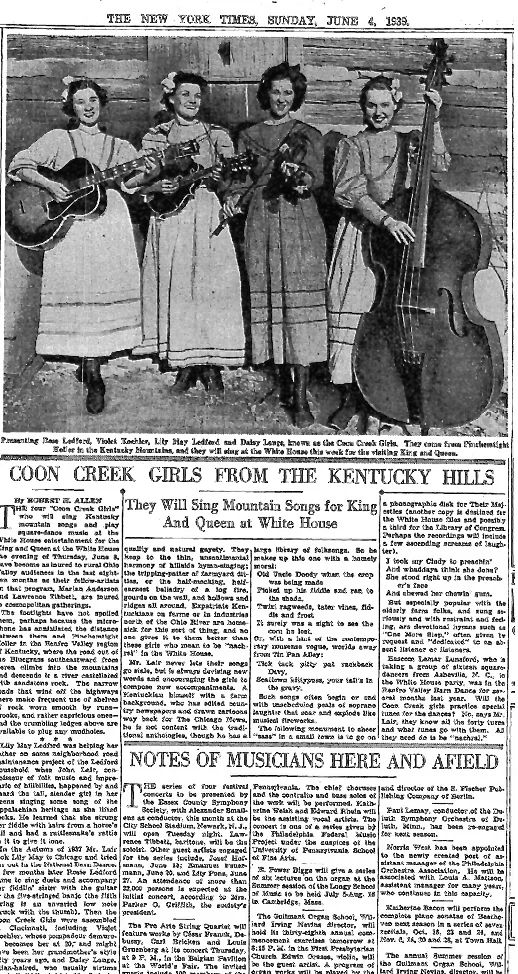
John Lilly, editor of the book Mountains of Music, described the girls “singing about ham and biscuits to the caviar crowd, with the leaders of the Western World sitting just one broken string’s length away.”
The Roosevelts and Queen Elizabeth were smiling, Lilly said, but King George “looked dour and dead-pan.” As the show went on, though, “their hearts were put at ease as they glanced to the floor and saw George VI quietly tapping his royal foot in time to the music.”
In 1973, the Osborne Brothers were the first Bluegrass stars to perform at the White House. Sonny Osborne said he got the impression that President Richard Nixon “was not overly enthused with Bluegrass music,” but the appearance was a “fun thing . . . and a once-in-a-lifetime deal.”
Bill Monroe and the Bluegrass Boys performed several times in Washington. In his book, On the Bus With Bill Monroe, band member Mark Hembree recalled an East Room luncheon in 1979 when his boss made a power move to sit with President Jimmy Carter.
Later, at a Ford’s Theater concert, Monroe sang “Blue Moon of Kentucky.” Hembree said Monroe “leaned into that red-hot mike, blowing away the first few rows. I saw Carter’s eyes bug out and it definitely shook up the audience.”
Monroe was invited back to the White House in 1980 for a South Lawn concert with Doc and Merle Watson. The Father of Bluegrass also returned for events hosted by Presidents Ronald Reagan, George H.W. Bush and Bill Clinton.
The Johnson Mountain Boys and the Bluegrass Student Union (more of a barbershop quartet) also played in the Reagan years, while Ricky Skaggs and the Nashville Bluegrass Band performed during the G.H.W. Bush era.

President Bill Clinton was known for playing the sax with jazz and rock stars. But in 1995 he sat with other enthusiastic fans for a “Women of Country” concert by Alison Krauss, Suzy Bogguss and Kathy Mattea (backed by Chet Atkins).
Dr. Ralph Stanley, The Grascals and Jimmy Bowen played at the White House during President George W. Bush’s administration, while Bela Fleck, Alison Krauss, Dan Tyminski and Sierra Hull performed for President Barack Obama. Krauss and Skaggs returned to receive the National Medal of Arts from President Donald Trump.
The Fiddler On The Hill
On the other end of Pennsylvania Avenue, the (turn)tables turned in 1978 when a top elected official recorded an album on Capitol Hill—backed by members of a legendary Bluegrass group.

Senate Majority Leader Robert Byrd regarded his fiddle playing as a key to his long political career in West Virginia. He decided to make an album called “Mountain Fiddler” on County Records. The producer was Barry Poss, who’d go on to found roots-music label Sugar Hill Records.
Poss told the Charleston (West Virginia) Gazette-Mail that his first call was to ask Doyle Lawson to head the back-up musicians. “He was just the right person because Doyle is a born leader,” Poss said.
Lawson played guitar and recruited fellow members of The Country Gentlemen—James Bailey on banjo and Spider Gilliam on bass. Setting up recording equipment in Byrd’s office put the Senator at ease, and the 14-song album found its audience and is still available on Amazon.
One reviewer commented that “what one would expect to be a vanity project turned out to be a genuinely enjoyable performance by one of America's most powerful politicians.”


